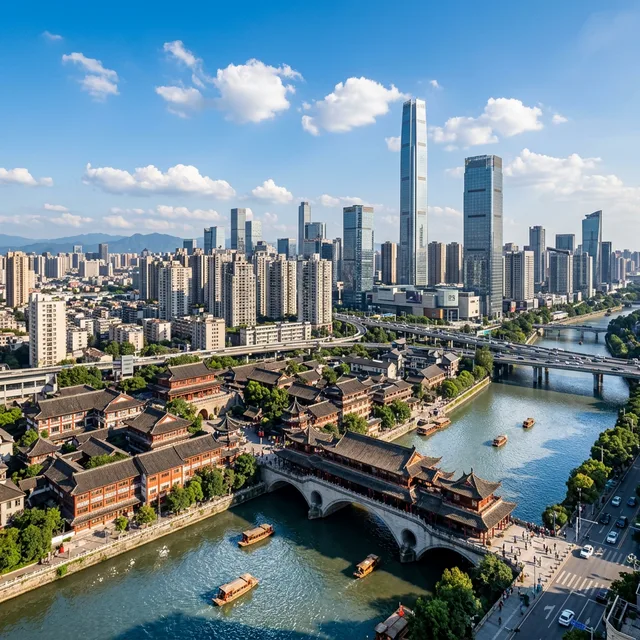
🏙️ Financial District & Modern Hong Kong
Hong Kong’s modern landscape represents the pinnacle of Asian economic power and architectural innovation.
- Central District: The financial heart of Hong Kong and Asia’s most densely concentrated collection of high-rise architecture. The HSBC Main Building (Norman Foster, 1985) cost US$668 million to build — then the world’s most expensive building — and its exposed structural frame and modular floor plates were revolutionary. It faces the Bank of China Tower (I.M. Pei, 1990) across Statue Square, creating a pair that together define Hong Kong’s architectural ambition. The elevated walkway system (Mid-Levels Escalator) connects Central to Soho restaurants and PMQ design market.
- Victoria Harbour: The 41 sq km harbor between Hong Kong Island’s north shore and the Kowloon Peninsula is one of the world’s great urban waterways. The nightly Symphony of Lights laser and LED show coordinated across the harbor skyline runs at 8pm daily and is free to watch from the Tsim Sha Tsui promenade on the Kowloon side. The harbor narrows to about 1.5km at its tightest point — at rush hour, dozens of vessels (Star Ferries, cargo junks, hydrofoils, and pleasure boats) cross simultaneously in what remains one of Asia’s most kinetic harbor scenes.
- International Finance Centre (IFC): The Two IFC tower (88 floors, 412 meters) houses the Hong Kong Monetary Authority’s museum of financial history on the 55th floor — free to visit and offering a legitimate excuse to experience the building’s observatory-grade views. The IFC Mall below connects by climate-controlled walkway to the Airport Express at Hong Kong Station, making it possible to check your luggage and collect boarding passes at the station before spending your last hours in the city.
- Star Ferry Pier: The iconic green-and-white double-decker ferries have crossed Victoria Harbour since 1888, and the 10-minute crossing from Tsim Sha Tsui (Kowloon) to Central or Wan Chai costs the equivalent of a few US cents — one of the world’s greatest-value scenic journeys. Buy a stored-value Octopus card for seamless boarding. The Tsim Sha Tsui pier was rebuilt in 2006 after the original 1957 pier (scene of riots when it was threatened with demolition) was controversially torn down.
- Bank of China Tower: Designed by I.M. Pei and completed in 1990, the 70-floor tower’s geometry is based on a cubic volume quartered diagonally and then progressively removed, creating a crystalline form of triangular prisms that reflects different aspects of the harbor depending on the angle and time of day. The building was controversial on feng shui grounds — the sharp angular lines were said to direct negative energy toward Government House and other neighbors. A public viewing floor on the 43rd level is accessible during business hours.
🏛️ Cultural Heritage & Historic Sites
Hong Kong’s cultural sites showcase the city’s rich Chinese heritage and colonial history.
- Temple Street Night Market: Running through the Jordan and Yau Ma Tei neighborhoods from 6pm to midnight, Temple Street is Hong Kong’s most atmospheric street market — a dense corridor of stalls selling watches, phone cases, gadgets, and clothing alongside fortune tellers (physiognomists, palm readers, and kau cim stick-shakers) and the occasional Cantonese opera busker. The street food stalls clustered around the Tin Hau Temple midway through the market serve some of the best inexpensive seafood in Kowloon — dai pai dong (open-air street restaurant) style.
- Man Mo Temple: Built in 1847 and one of Hong Kong’s oldest surviving temples, Man Mo on Hollywood Road in Sheung Wan is dedicated to two Taoist deities: Man Cheong (god of literature) and Mo Tai (god of martial arts and war — later worshipped as Kwan Tai). The interior is perpetually smoke-filled from the enormous coiled incense spirals hanging from the ceiling, which burn for weeks. Brass bells, elaborately carved wooden sedan chairs (used to carry the deity statues in processions), and continuous incense offerings make it one of the most atmospheric active temples in the city. Entry is free.
- Po Lin Monastery & Tian Tan Buddha: On Lantau Island, the Po Lin (Precious Lotus) Monastery was established in 1906 by three Buddhist monks. The Tian Tan Buddha (seated bronze statue, 34 meters tall, completed 1993) requires climbing 268 steps and is visible from the Ngong Ping cable car long before arrival. The monastery vegetarian restaurant serves good-value set meals to the many visitors. The cable car from Tung Chung (on the Airport Express line) provides the most scenic approach; the Ngong Ping 360 cable car runs 5.7km over forested mountains and coastline.
- Stanley Market: The former military barracks town of Stanley on Hong Kong Island’s southern coast houses a rambling market in lanes between colonial-era buildings, selling linen, artwork, brand-name sportswear (sometimes genuine surplus, sometimes otherwise), and tailored goods. The seafront promenade has waterfront restaurants with views of Lamma Island. Stanley Main Street’s Murray House — a colonial administrative building originally built in 1844 in Central and painstakingly dismantled stone by stone and re-erected here in 2000 when its original site was needed for the IFC construction — is an unusual piece of architectural archaeology.
- Wong Tai Sin Temple: One of Hong Kong’s most visited temples, Wong Tai Sin (Sik Sik Yuen) in Kowloon is a Taoist temple complex dedicated to the 4th-century immortal Wong Tai Sin, who is believed to grant wishes. The temple is famous for kau cim fortune-telling — worshippers shake a cylinder of numbered bamboo sticks (kau cim sticks) until one falls out, then consult a fortune reader to interpret the corresponding poem. The complex covers 18,000 sq meters with prayer halls, gardens, and multiple shrines. Busiest during Chinese New Year (January/February), when thousands come for the first kau cim reading of the year.
🏔️ Natural Wonders & Outdoor Activities
Hong Kong’s natural sites offer respite from urban intensity and outdoor adventures.
- Victoria Peak & Peak Tram: The Peak Tram (opened 1888, the oldest funicular railway in Asia) climbs the 396-meter Victoria Peak from Garden Road, with a maximum gradient of 27 degrees — steep enough that during the climb, buildings outside the windows appear to lean dramatically. The 360-degree view from the Peak Tower (rebuilt 1997) is Hong Kong’s most iconic panorama: the skyscraper forest of Central below, Victoria Harbour, Kowloon, and on clear days the Chinese mainland. The tram queue can be very long; book timed tickets online. The 3.5km Peak Circle Walk (paved, free, 1 hour) around the contour of the peak offers comparable views with far fewer people.
- Dragon’s Back Hike: Consistently voted one of Asia’s best urban hikes, Dragon’s Back follows a ridge trail on Hong Kong Island’s east with panoramic views of the South China Sea, the outer islands, and Shek O village below. The 8.5km trail from Shek O Road to Big Wave Bay (or vice versa) takes 2–3 hours at a comfortable pace and ends near bus connections back to the city. Go on a clear weekday for the best visibility; morning mist often burns off by 10am.
- Lantau Island: Hong Kong’s largest island (twice the size of Hong Kong Island) contains the international airport, the Tian Tan Buddha, Disneyland, and substantial untouched country park covering around 70% of its area. The Lantau Trail is a 70km long-distance hiking circuit taking 3–4 days to complete. The Tai O fishing village on the west coast — stilted houses over tidal channels, traditional salt-fish drying, and resident pink dolphins in the estuary — offers the most complete picture of pre-development Hong Kong life.
- Repulse Bay Beach: The widest and most popular beach on Hong Kong Island, with calm swimming conditions (enclosed bay, lifeguard service) and a backdrop of luxury apartment towers that spectacularly illustrate Hong Kong’s real estate values. The elaborate Tin Hau (sea goddess) shrine complex at the southern end of the beach features large statues of deities and a “longevity bridge” whose passage is said to add three days to one’s life. The adjacent Repulse Bay Hotel (1920s colonial original; the current building is a 1986 reproduction) has a popular afternoon tea service.
- Nan Lian Garden: A classical Chinese garden in the Tang Dynasty style, built in 2006 adjacent to Chi Lin Nunnery in Diamond Hill, Kowloon. The 3.5-hectare garden contains pavilions, bridges, lotus ponds, bonsai trees, and carefully arranged rockeries — all using traditional materials and construction methods without a single nail. The adjacent Chi Lin Nunnery complex (built 1998 entirely in Tang dynasty architectural style, also without nails) is one of the largest wooden religious complexes built in the 20th century. Both are free to enter and form one of Hong Kong’s most unexpected tranquil spaces.
🍜 Culinary Excellence & Street Food
Hong Kong’s food scene represents the pinnacle of Cantonese cuisine and culinary innovation.
- Dim Sum (點心): Hong Kong’s most beloved meal is yum cha (tea drinking) — the ritual morning or lunchtime visit to a Cantonese restaurant where bamboo baskets of small dishes arrive continuously. Classic dim sum: har gow (shrimp dumplings with translucent rice-flour skin, judged by how thin and non-sticky the skin is — the mark of a good kitchen), siu mai (pork and shrimp open dumplings topped with crab roe), turnip cake (lo bak go, pan-fried until crispy), and the egg tart (smooth, barely sweet custard in a buttery pastry shell). Lin Heung Tea House (founded 1926, pushcart service), Tim Ho Wan (the world’s cheapest Michelin-starred restaurant), and Lung King Heen (Four Seasons Hotel, three Michelin stars) represent the full spectrum.
- Street Food Markets: The best street food concentration is in Sham Shui Po (Kowloon) around Apliu Street and in the side streets of Wan Chai. Look for: curry fish balls (the street food most associated with Hong Kong, served on wooden skewers from large pots of simmering spiced sauce), fresh tofu fa (silken tofu dessert with ginger syrup), pineapple bun (bo lo baau — a sweet soft bun with a crunchy sugar-topped dome, best eaten split and buttered while hot), and stinky tofu (fermented, deep-fried, detectable at 50 meters). Night markets in Jordan and Mong Kok are best from 9pm–midnight.
- Roast Goose & BBQ: Hong Kong’s siu mei (barbecue) tradition produces some of the world’s finest roasted meats. Roast goose (siu ngoh) — a specifically Cantonese specialty rare outside Hong Kong and Guangdong — is brined, air-dried, and roasted until the skin crackles and the fat renders completely. Yung Kee (Central, since 1942) and Kam’s Roast Goose (one Michelin star, Wan Chai) are the most celebrated addresses. Char siu (BBQ pork) appears in all price categories from dai pai dong to fine dining.
- Seafood Restaurants: The fishing village of Lei Yue Mun in eastern Kowloon operates a live seafood market where you choose your fish, crab, lobster, or shellfish from tanks, agree on a price per gram, then take it to one of the adjacent restaurants to have it cooked to your specification. The experience — essentially picking your dinner alive — is quintessentially Hong Kong. Aberdeen Floating Village on Hong Kong Island’s south side has a similar (more tourist-oriented) cluster of seafood restaurants.
- International Fusion: Hong Kong’s role as Asia’s most cosmopolitan trading port for 180 years produced genuine culinary fusion rather than theme-restaurant pastiche. Hong Kong-style milk tea (a blend of Ceylon teas strained through a cloth “silk” filter, mixed with evaporated milk, served sweet and extremely strong) is the most characteristic invention. Cha chaan teng (tea restaurants) serve a hybrid menu of toast with butter and condensed milk, Hong Kong-style French toast (bread dipped in egg and deep-fried, served with syrup), and Hong Kong-style instant noodles — a low-cost food culture that developed uniquely on this island.
- Tea Houses & Cha Chaan Teng: The cha chaan teng (literally “tea restaurant”) is Hong Kong’s most distinctive dining institution — casual all-day cafes with laminated menus, efficient if not always polite service, and a menu covering breakfast, lunch, and snacks at very low prices. The food culture here developed because of Hong Kong’s tiny apartments (no room to cook) and long working hours. Classics include the combo breakfast (toast, egg, and either milk tea or coffee/milk tea mixture called “yuenyeung”), pork chop bun, and instant noodles in soup with everything from spam to seafood.
🚇 Practical Hong Kong Guide
- Best Time to Visit: October-November for pleasant weather and cultural festivals, or March-May for cherry blossoms but expect humidity. Hong Kong offers subtropical climate. Autumn is ideal. Spring is beautiful. Summer is hot and humid. Winter is mild and comfortable.
- Getting Around: Excellent MTR metro system connecting all areas efficiently. Ferries, buses, and minibuses also available. Walking in central areas feasible. The MTR is world-class. The system is extensive. Tickets are affordable. The efficiency is remarkable.
- Planning & Tickets: Book Peak Tram and major attractions online. Octopus card essential for transport. Many sites free or low-cost. The city requires some planning. Apps are useful. English is widely spoken in tourist areas.
- Safety & Etiquette: Generally safe but crowded. Respect local customs and queue politely. Hong Kong is orderly and polite. The people are helpful. The culture values harmony. The city is welcoming to tourists.
- Cost Considerations: Expensive for accommodation but reasonable for food and attractions. Budget €150-300 per day. Street food is affordable. Public transport inexpensive. Luxury experiences costly. The city offers good value for quality.
- Cultural Notes: Hong Kong blends Chinese and Western cultures harmoniously. The city represents cultural fusion. Hong Kong is dynamic and innovative. The people are hardworking. The culture is respectful.
- Language: Cantonese and Mandarin primary, English widely used in business and tourism. Hong Kong is bilingual. The English is good. Communication is easy. The signage is multilingual.
- Time Zone: Hong Kong Time (HKT), UTC+8. No daylight savings observed.