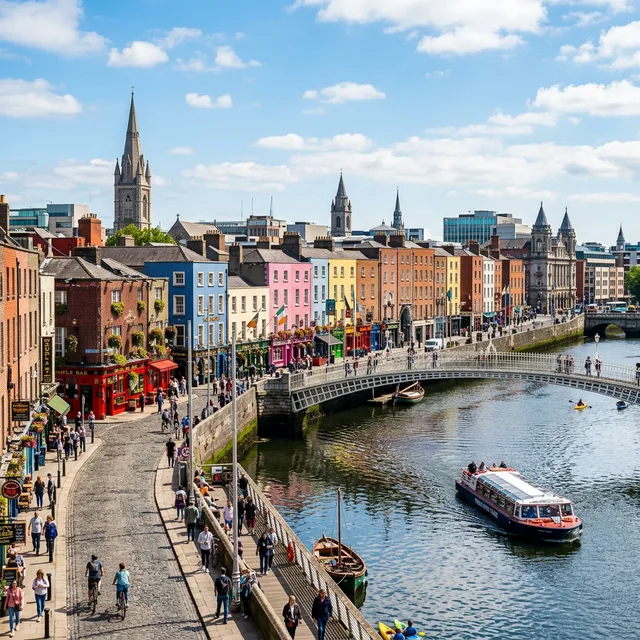

🍺 Guinness & Irish Culture
Dublin is the birthplace of Guinness and the heart of Irish pub culture that defines the city’s social life.
- Guinness Storehouse: Built around a seven-story atrium shaped like a pint glass, the Storehouse sits at St. James’s Gate where Arthur Guinness signed his famous 9,000-year lease in 1759. The tour traces the brewing process from barley to barrel, and culminates at the Gravity Bar on the top floor — a 360-degree glass panorama over the Dublin rooftops where you receive a complimentary pint. Book online in advance; it’s Ireland’s most visited tourist attraction and queues can be long without a timed entry.
- Jameson Distillery Bow St.: The original Jameson distillery in Smithfield has been converted into an immersive museum in a beautifully preserved Victorian industrial building. Tours include a comparative tasting of Irish, Scotch, and American whiskeys that helps explain what makes Irish triple-distilled whiskey distinctively smooth. The “Whiskey Makers” experience offers a deeper hands-on session for serious enthusiasts.
- Temple Bar District: Dublin’s cultural quarter is a compact grid of cobblestoned streets between Dame Street and the river Liffey. It contains genuine traditional pubs like The Brazen Head (Dublin’s oldest, established 1198) alongside tourist-targeted bars. The Oliver St. John Gogarty and The Temple Bar pub itself are reliable for live traditional music sessions nightly. Expect high prices and lively crowds — locals generally drink elsewhere, but Temple Bar is worth a walk-through for its energy and architecture.
- Traditional Irish Music Pubs: For authentic sessions away from Temple Bar, head to Mulligan’s (Poolbeg Street, since 1782), Hughes’ Bar in Smithfield, or O’Donoghue’s on Merrion Row — where the Dubliners first performed in the 1960s. Sessions typically start around 9pm and are free to attend. The music features fiddles, flutes, uilleann pipes, bodhráns, and singing in a participatory, informal setting.
📚 Literary Heritage & Trinity College
Dublin is the literary capital of Ireland, home to countless writers and the world’s most famous illuminated manuscript.
- Trinity College Dublin: Founded in 1592 by Queen Elizabeth I, Trinity is Ireland’s oldest university and an extraordinary piece of Georgian architecture in the heart of the city. The cobbled Fellows’ Square is open to the public, and the campus’s famous 18th-century library is home to the Book of Kells. Queues for the library can be significant — book the combined Book of Kells and Old Library ticket online to skip the line. The college is also free to walk through and makes a peaceful detour from the surrounding city streets.
- The Book of Kells & Long Room: Created around 800 AD by Celtic monks, possibly on the island of Iona in Scotland, the Book of Kells is an illuminated gospel manuscript of extraordinary intricacy — the equivalent of a medieval masterpiece requiring years to complete. Two of the four volumes are displayed at a time, one showing an illustration, the other showing the dense calligraphic text. Upstairs, the Old Library’s Long Room is one of Europe’s most magnificent library spaces: 65 meters of barrel-vaulted oak ceiling and two-story shelves holding 200,000 of Trinity’s oldest books, including a rare 1916 Proclamation of the Irish Republic.
- Dublin Writers Museum: Located in a restored 18th-century mansion on Parnell Square, the museum covers Dublin’s extraordinary literary history through manuscripts, letters, first editions, and personal objects. The collection spans Jonathan Swift (who lived and died in Dublin), Oscar Wilde (born on Westland Row), W.B. Yeats, George Bernard Shaw, James Joyce, Samuel Beckett, and Brendan Behan — an astonishing concentration of literary genius for one small city.
- James Joyce Cultural Centre: Housed in a restored Georgian townhouse on North Great George’s Street — a street that features prominently in Ulysses — the centre explains Joyce’s life, his complex relationship with Dublin (he left but wrote almost exclusively about it), and provides guides for following the Bloomsday walking route. The annual Bloomsday Festival on June 16th sees the whole city celebrate Ulysses, with readings, dramatizations, and Joycean fancy dress.
🏰 Georgian Dublin & Historic Sites
Dublin’s historic sites showcase its complex history from Viking origins to modern times.
- Dublin Castle: Built by King John of England in 1204 on the site of a Viking fortress, the castle served as the administrative center of British rule in Ireland for 700 years. The State Apartments — used today for presidential inaugurations and EU Council meetings — are lavishly decorated in Georgian style. The medieval undercroft is visible through a glass floor, showing the original Viking and Norman foundations. The Chester Beatty Library (see Arts section) is housed in the castle’s garden buildings.
- St. Stephen’s Green: A 22-acre Victorian park in the heart of Georgian Dublin, redesigned and given to the city in 1880 by Arthur Guinness (Lord Ardilaun). The park’s ornamental lake, bandstand, and formal flowerbeds provide a genuine green lung in the city center. During the 1916 Easter Rising, Countess Markievicz and a contingent of Irish Volunteers occupied the park before being ordered to abandon it. A monument to Wolfe Tone stands at the Grafton Street corner.
- Phoenix Park: At 1,752 acres, Phoenix Park is one of Europe’s largest enclosed city parks — larger than Central Park in New York. It contains Áras an Uachtaráin (the President’s official residence, visible from the road), the Dublin Zoo (one of Europe’s oldest, founded 1831), and a herd of wild fallow deer that have lived in the park since the 17th century. The Papal Cross marks where John Paul II held Mass for 1.25 million people in 1979 — still the largest gathering in Irish history.
- Georgian Architecture & Merrion Square: Dublin’s Georgian squares — Merrion, Fitzwilliam, Mountjoy, and Parnell — were built in the 18th century and represent some of the finest Georgian townhouse architecture in Europe. Merrion Square’s famous painted doors (each a different color to help residents find their way home before street lighting) and the park in the center (where Oscar Wilde grew up across the road) make it the best square to visit. The park contains a languid Oscar Wilde monument that has become one of Dublin’s most photographed sculptures.
🎭 Arts & Contemporary Culture
Dublin’s cultural scene combines traditional Irish arts with contemporary creativity.
- National Gallery of Ireland: Free to enter, the National Gallery on Merrion Square West holds Ireland’s primary collection of fine art, including a significant permanent collection of works by Jack B. Yeats (brother of the poet), as well as paintings by Rembrandt, Caravaggio, and Vermeer. The Millennium Wing houses temporary exhibitions of international quality. The gallery was where George Bernard Shaw spent much of his Dublin childhood education — he later bequeathed a third of his estate to the institution.
- Dublin Theatre Festival: Held each October, the Dublin Theatre Festival is one of Europe’s leading dedicated theatre festivals, with productions staged across the city’s major venues including the Abbey Theatre (Ireland’s national theatre, founded 1904), the Gate, and the Project Arts Centre. It regularly premieres world-class productions that subsequently transfer to London and Broadway.
- Chester Beatty Library: Consistently rated among the world’s best small museums, the Chester Beatty holds the collection of American mining magnate Sir Alfred Chester Beatty, donated to Ireland upon his death in 1968. The collection spans 6,000 years and includes Qur’an manuscripts with breathtaking calligraphy, Japanese woodblock prints, ancient Egyptian papyri, Buddhist manuscripts from Burma and Tibet, and some of the earliest dated printed books in the world. Entry is free.
- Irish Music & Cultural Venues: The National Concert Hall on Earlsfort Terrace hosts the RTÉ National Symphony Orchestra and international artists. The Vicar Street venue books major rock and folk acts in an intimate setting. Whelan’s on Wexford Street has launched dozens of Irish artists over three decades. The Irish traditional music scene is most alive in small neighborhood pubs — ask locally for the nearest genuine session night.
🍲 Irish Cuisine & Local Specialties
Dublin’s culinary scene reflects Ireland’s agricultural heritage and growing international influences.
- Traditional Irish Stew: A genuine lamb and root vegetable stew slow-cooked with potatoes, carrots, onions, and thyme — historically a peasant dish, now a pub staple. The best versions use neck or shoulder of lamb and cook for hours until the broth is silky. Gallagher’s Boxty House in Temple Bar does a reliable version; the Winding Stair on the quays pairs good Irish stew with a river view.
- Irish Breakfast: The “full Irish” features back bacon (thicker and meatier than streaky), pork sausages, a fried egg, black pudding (blood sausage, often from Clonakilty in Cork), white pudding, grilled tomato, mushrooms, and soda bread or toast. It remains the best hangover cure in the Northern Hemisphere. Bewley’s Café on Grafton Street (in a beautiful 1927 Art Deco building) serves a reliable version at reasonable prices.
- Seafood from Dublin Bay: Dublin Bay prawns (actually Norway lobsters, also called langoustine) are one of Ireland’s finest ingredients — sweet, delicate, and delicious grilled simply with butter. Oysters from Carlingford and Clare Island, mussels from West Cork, and wild Atlantic salmon are all readily available. Klaw in the city center specializes in seafood, and the Woollen Mills on the quays has an excellent chowder.
- Craft Beer & Local Breweries: Beyond Guinness, Dublin has developed a thriving craft beer scene. Porterhouse Brewing (Bray and Dublin) pioneered it in the 1990s; newer players include Trouble Brewing (Kildare), White Hag (Sligo), and numerous taprooms across the city. The L. Mulligan Grocer on Stoneybatter has one of the best beer selections in Ireland alongside excellent food.
- Modern Irish Cuisine: Chefs like Derry Clarke at L’Ecrivain and Ross Lewis at Chapter One (both Michelin-starred) have established a distinctly Irish fine-dining tradition that uses native ingredients — dry-aged Wicklow beef, hand-dived scallops, Wexford strawberries — with classical French technique. The Greenhouse and Peploe’s are also worth booking well ahead for a special meal.
- Pub Food & Gastro Pubs: The gastropub revolution transformed Dublin eating in the 2000s. The Pig’s Ear near Trinity, The Cottage on Patrick Street, and the Bull & Castle near Christchurch all offer genuinely good cooking in heritage pub settings. Most pubs serve food 12–9pm; traditional pub grub includes beef and Guinness pie, fish and chips, and the ploughman’s board of Irish cheeses.
🚇 Practical Dublin Guide
- Best Time to Visit: May–June offers the best combination of long evenings (light until 9–10pm), mild temperatures (15–18°C), and smaller crowds before the July–August peak. September is excellent for festivals and autumn colour. St. Patrick’s Festival (March 17, with surrounding events) transforms the city but brings the largest crowds of the year. Rain is possible at any time — a light waterproof layer is essential whatever the season.
- Getting Around: The city center is compact and extremely walkable — most major sights are within a 30-minute walk of one another. The LUAS tram system has two cross-city lines useful for reaching Smithfield, St. Stephen’s Green, and the Docklands. The DART coastal rail connects Dublin city to Howth in the north and Bray in the south. Buses cover the suburbs. Dublin Bikes, the city’s bicycle hire scheme, has 100 stations throughout the center and is excellent for short hops.
- Guinness & Attraction Planning: Book the Guinness Storehouse, Trinity College Library, and any major temporary exhibition online in advance — especially June through August when queues without timed entry can be over an hour. The Dublin Pass covers entry to 35+ attractions and can offer good value for a visitor covering multiple sites in 2–3 days.
- Safety & Etiquette: Dublin is a very safe city for visitors. The main precaution is pickpocketing in very crowded areas (Grafton Street, Temple Bar on weekend nights). Irish pub etiquette involves buying rounds: if you join a group, expect to participate. The correct response when a pint is placed in front of you is “cheers” — loudly, with eye contact.
- Cost Considerations: Dublin is one of Europe’s more expensive capitals. A pint of Guinness costs €6–7.50, a pub meal €12–20, and a mid-range restaurant dinner €40–60 per person with wine. Many of the best attractions — Phoenix Park, the National Gallery, Chester Beatty Library, the National Museum — are free. Budget €90–160 per day for a comfortable visit with paid attractions and pub meals.
- Cultural Notes: Irish culture prizes wit, storytelling, and self-deprecation. Conversations in pubs with strangers are the norm — Dublin is one of the world’s easiest cities for solo travelers to meet people. The Irish relationship with their past is complex; the Easter Rising, the Famine, and partition are not abstract history here but living parts of cultural identity.
- Language: English is the everyday language throughout Dublin. Irish (Gaeilge) is a compulsory school subject and spoken natively in a few western communities (Gaeltacht areas), but rarely heard on Dublin streets. Street signs are in both languages; announcements on the DART and LUAS are made in Irish first, then English.
- Time Zone: Greenwich Mean Time (GMT), UTC+0. Daylight Savings Time observed (IST, UTC+1).


