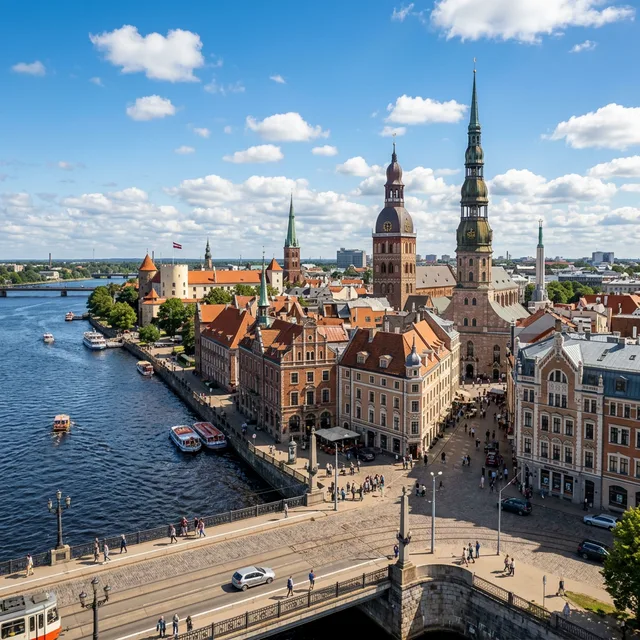

🏰 Medieval Old Town & UNESCO Heritage
Riga’s old town is a UNESCO World Heritage masterpiece of medieval Hanseatic architecture and Baltic history.
- Riga Old Town (Vecrīga): UNESCO World Heritage site featuring beautifully preserved medieval buildings, cobblestone streets, and Gothic architecture from Riga’s days as a Hanseatic trading city. Founded in 1201 by Bishop Albert of Bremen, Riga was a major trading hub in the Hanseatic League — the medieval north European commercial network — and the wealth from that era produced the exceptional architecture that survives today. The area is pedestrian-friendly, most efficiently explored on foot in a few hours.
- House of the Blackheads: The most spectacular building on Riga’s main square (Rātslaukums), originally built in 1334 for the Brotherhood of Blackheads — an association of unmarried foreign merchants who took their name from their patron, Saint Maurice, depicted as a Moorish knight on the building’s facade. The structure was heavily damaged in WWII and completely demolished by Soviet authorities in 1948; the painstaking reconstruction was completed in 2001. It now functions as a museum and concert venue. The Flemish Renaissance facade is richly decorated with coats of arms and carved figures.
- Riga Cathedral (Doma katedrāle): Latvia’s largest church, founded in 1211, making it one of the oldest in the Baltic states. The cathedral’s most famous feature is its organ — installed in 1884 and featuring 6,768 pipes, it was the largest organ in the world at the time of its construction. Regular organ concerts are held here; check the schedule as they’re excellent value and acoustically impressive. The cloister adjacent to the cathedral contains a museum of Riga’s medieval history.
- St. Peter’s Church: The distinctive Baroque spire (123 meters) was the tallest timber structure in Europe when built in the 17th century; the current spire is a 1970s reconstruction in steel after wartime damage. The viewing platform at 72 meters is accessible by lift and provides the best panoramic view of Old Riga, the Art Nouveau district, and the Daugava River. Open daily; entry around €9.
🏛️ Art Nouveau Architecture
Riga boasts the world’s largest collection of Art Nouveau buildings, a UNESCO-recognized architectural treasure.
- Art Nouveau District: Riga’s Art Nouveau heritage developed rapidly between 1896 and 1913 — a period of intense economic growth when much of the city was built or rebuilt. The city now has over 800 buildings in Art Nouveau styles, representing about one-third of all buildings in the historic city. This concentration is unmatched anywhere in the world; UNESCO specifically recognized the Art Nouveau ensemble alongside the medieval old town in 1997. The styles range from eclectic ornamental (with elaborate human faces, animals, and plant motifs on facades) to German Jugendstil to National Romanticism using Latvian folk motifs.
- Alberta iela (Albert Street): The most concentrated showcase of ornamental Art Nouveau, designed largely by Mikhail Eisenstein (father of filmmaker Sergei Eisenstein) between 1903 and 1908. Number 2a, 4, 6, 8, and 13 are particularly extraordinary — human masks, sphinxes, lions’ heads, and screaming figures cover every surface. Walk the length of Alberta iela twice: once looking up and once looking at the ground-floor details. Photography here is spectacular at any time of day.
- Jugendstil Museum: A recreated Art Nouveau apartment at Alberta iela 12, apartment 9, with period furniture, wallpaper, and objects from the early 1900s. The apartment itself is a modest size but the curation is excellent, placing the architecture in the social context of its middle-class original residents. Guided tours in English available.
- Art Nouveau Walking Tours: The tourist office offers a dedicated Art Nouveau walking route map (free download). Key streets beyond Alberta: Elizabetes iela, Strēlnieku iela, and Antonijas iela all have significant buildings. The “cat house” on Meistaru iela (1909) — with two cats on the turrets, supposedly positioned with tails raised toward the Riga Guild House in a dispute between the building’s owner and the guild — is one of the most photographed buildings in the city.
🏛️ Soviet History & Occupation Museum
Riga’s museums chronicle Latvia’s complex 20th-century history under Soviet and Nazi occupation.
- Museum of the Occupation of Latvia: Located on Rātslaukums (Town Hall Square), the museum covers the period 1940–1991 during which Latvia was occupied first by the USSR (1940–41), then Nazi Germany (1941–44), and again by the USSR (1944–1991). The exhibits draw heavily on personal testimonies and artifacts from deportees — Latvia lost approximately one-third of its pre-war population through Soviet deportations, Nazi genocide of the Jewish community, and wartime flight. The museum opened in 1993, just two years after independence, making it one of the earliest and most direct confrontations with occupation history in any post-Soviet state. Free admission; donation requested.
- Riga Castle (Rīgas pils): The medieval castle at the northern tip of the old town has served as the seat of the President of Latvia since independence. The castle was being extensively renovated for most of the 2010s after a fire; it now houses three museums — the Museum of Latvia’s History, the Museum of Foreign Art, and Rainis and Aspazija House (dedicated to Latvia’s greatest poet and playwright). The exterior is most impressive from the Daugava River embankment.
- Latvian Ethnographic Open-Air Museum: Located on the shores of Lake Jugla, 8km from the city center, the outdoor museum was founded in 1924 and contains 118 authentic historic buildings moved from across Latvia — farmhouses, windmills, fishermen’s smokehouses, and a 17th-century church. Craftspeople demonstrate traditional skills on weekends. The setting on the lake shore is genuinely beautiful; it’s a full half-day excursion from the center.
- KGB Building Memorial: The “Corner House” (Stūra māja) at the intersection of Brīvības iela and Stabu iela served as the headquarters of the Latvian KGB (Soviet secret police) from 1944 to 1991. The basement detention and interrogation cells have been preserved as a memorial; guided tours take visitors through the cells where thousands of Latvians were imprisoned. Opened as a memorial in 2014; tours must be booked in advance.
🎭 Culture & Arts
Riga’s cultural scene combines Latvian traditions with international influences and a thriving arts community.
- Latvian National Opera: One of the oldest opera houses in the Baltic region, founded in 1919, housed in a neoclassical building from 1863. The company has a long tradition of international guest soloists and a resident ballet company. Ticket prices are extremely reasonable by European standards — good seats for major productions are often €20–40. The programming balances mainstream opera and ballet repertoire with Latvian and Baltic premieres.
- Freedom Monument (Brīvības piemineklis): The 42-meter granite and copper monument was erected in 1935 on the initiative of public donations, and carries on its top the female figure Milda holding three golden stars representing the three historical regions of Latvia (Vidzeme, Kurzeme, Latgale). During the Soviet occupation, the monument survived only because authorities couldn’t figure out how to remove it without damaging surrounding buildings. Unofficial ceremonies at the monument during the 1980s Soviet period became focal points of Latvian independence resistance; it remains the gathering place for national celebrations.
- Riga Central Market: Built in 1930 in five repurposed German WWI Zeppelin hangars — the largest Zeppelin sheds in the world at the time — each hangar is dedicated to a different type of produce: meat, fish, dairy, produce, and dry goods. The market is used daily by Riga residents and is genuinely one of the great European food markets. Arrive before 10am for the best atmosphere and freshest fish. UNESCO World Heritage site.
- Bastion Hill (Basteja kalns): A landscaped hill created from the earthworks of Riga’s 17th-century city bastions, now a public park with an outdoor stage and the small Bastejkalns canal. The Swedish Gate (1698) nearby is the only remaining city gate in Riga’s old fortifications. The hill is a central meeting point and concert venue in summer.
🌊 Daugava River & Waterfront
The Daugava River defines Riga’s geography and offers scenic beauty and recreational opportunities.
- Daugava River Embankment: The west bank of the Daugava facing Old Riga offers the best views of the city’s silhouette — the spires of St. Peter’s, Riga Cathedral, and the castle tower visible in sequence. The embankment promenade on the right bank (Andrejosta area) is being developed into a creative district with galleries, restaurants, and event spaces in former port buildings.
- Stone Bridge & Vanšu Bridge: The Stone Bridge (Akmens tilts), built 1981, carries trams and cars; the Cable Stay Bridge (Vanšu tilts), built 1981 with a 108-meter single pylon, is one of the more elegant examples of Soviet-era engineering. Both offer pedestrian access and views back over Old Riga.
- River Cruises: One-hour Daugava River cruises operate from the embankment near the Stone Bridge from May through September, offering views of the old town from the water. Evening cruises in summer catch the city in evening light. Prices are typically €15–20.
- Zaķusala Island: An island in the Daugava accessible by the cable-stayed bridge, hosting a beach (Zaķusala pludmale) that opens in summer, a yacht harbor, and recreational areas. The beach is free; facilities are basic but the swimming in the river is popular with Rigans on hot days.
🍲 Latvian Cuisine & Baltic Specialties
Riga’s culinary scene reflects Latvia’s agricultural heritage and Baltic influences, with emphasis on fresh, seasonal ingredients.
- Traditional Latvian Cuisine: Grey peas with bacon (pelēkie zirņi ar speķi) is Latvia’s most traditional dish — dried field peas cooked with onion and cubes of smoked pork fat, served at Christmas, midsummer, and in traditional restaurants year-round. Skābēņu zupa (sorrel soup) is tangy and served cold in summer or warm in winter. Cold-smoked and hot-smoked fish — herring, eel, flounder — from the Baltic coast and Latvian rivers is excellent throughout the year.
- Riga Black Balsam: A herbal liqueur developed in 1752 by pharmacist Abraham Kunze as a medicinal product and sold in the distinctive black ceramic bottles since the 19th century. Made from 24 plant ingredients including valerian root, wormwood, linden blossom, peppermint, and oak bark, macerated in neutral spirit. The taste is intensely bitter and complex. Traditionally consumed neat as a digestive or mixed with blackcurrant juice to soften the bitterness. Available in every shop and restaurant; bottles make authentic souvenirs.
- Central Market Specialties: The fish hall at Riga Central Market is the best place to buy Baltic sprats (brisolīngs) — small oily fish traditionally smoked with alder wood — as well as fresh pike-perch, herring roe, smoked eel, and Latvian dairy products including cottage cheese (biezpiens) and sour cream. The bread hall carries dense, dark rye bread (rupjmaize) — sour and malty, the foundation of the Latvian diet for centuries.
- Modern Latvian Restaurants: The past decade has seen a genuine Latvian culinary renaissance, with chefs applying Nordic-style techniques to local ingredients. Vincents (Chef Mārtiņš Rītiņš) has been Riga’s flagship fine dining restaurant since 1994. Bibliotēka No.1 serves creative modern Latvian in the National Library. For more casual but quality food, Lido is a Latvian cafeteria chain serving traditional food at very low prices across multiple large locations.
- Beer Culture & Craft Breweries: Latvian beer culture centers on lager brewing with malt-forward flavors. The Valmiermuiža brewery from northern Latvia produces an excellent pale amber ale available throughout Riga. The craft beer scene centered on the Miera iela neighborhood in Riga proper includes several small breweries and taprooms. Aldaris (founded 1865) is the major commercial producer; the brewery tour includes a museum of Latvian brewing history.
- Sprats & Baltic Seafood: Riga Sprats (Rīgas brētliņas) — smoked in traditional wood-fired smokehouses and canned in oil or tomato sauce — are an Latvian export product with genuine international reputation. The process was documented enough that authentic Riga sprats received EU protected geographical indication status. Fresh Baltic herring (reņģe) is available at the central market from May through October; the traditional preparation is lightly salted and eaten with rye bread and onion.
🚇 Practical Riga Guide
- Best Time to Visit: May-June or August-September for mild weather and cultural events. Summer brings long daylight hours. Winter is cold but Riga offers great indoor attractions. The city hosts many festivals throughout the year. Spring and fall offer pleasant walking weather.
- Getting Around: Excellent public transport with trams, buses, and a metro line. The city center is very walkable. Riga is compact and pedestrian-friendly. Taxis are inexpensive. The transport system is efficient and clean.
- Museum & Attraction Planning: Book Riga Castle tours in advance. Many museums offer English audio guides. Combined tickets save money. The city is easy to navigate on foot. Most attractions are centrally located.
- Safety & Etiquette: Very safe city with low crime rates. Latvians are friendly but reserved initially. English is widely spoken. The city has a welcoming atmosphere. Respect for historical sites is appreciated.
- Cost Considerations: Very affordable compared to Western European cities. Budget €60-120 per day. Museums and restaurants are reasonably priced. Public transport is inexpensive. The city offers excellent value for culture.
- Cultural Notes: Riga represents the Baltic region’s complex history and cultural resilience. The city’s architecture tells stories of prosperity and hardship. Latvian culture values tradition alongside modernity. The city combines Hanseatic heritage with Soviet history. Riga’s multicultural past is visible everywhere.
- Language: Latvian is the official language, but Russian and English are widely spoken. Many signs are multilingual. The Latvian language is ancient and unique. English proficiency is high in tourist areas.
- Time Zone: Eastern European Time (EET), UTC+2. Daylight Savings Time observed (EEST, UTC+3).


