
🏰 Old Montreal & Historic Heritage
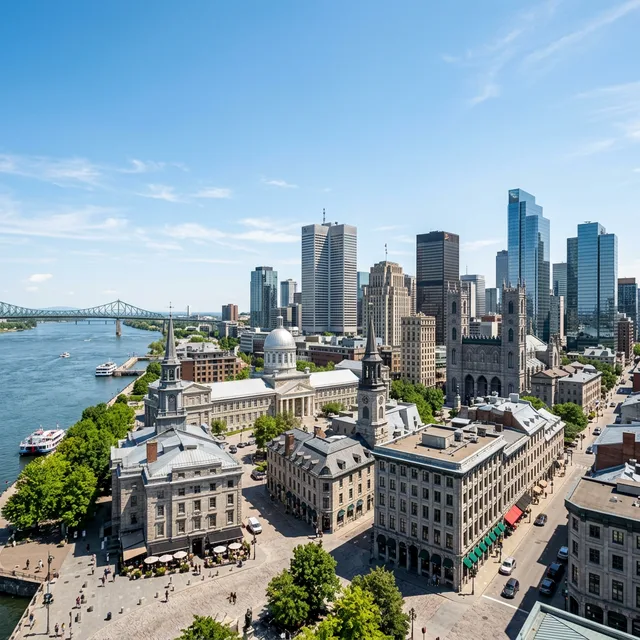
Montreal’s historic Old Town represents the city’s French colonial origins and architectural charm.
- Old Montreal (Vieux-Montréal): The oldest part of the city, founded in 1642 as Ville-Marie, occupies the waterfront along the St. Lawrence River. The cobblestone streets of Rue Saint-Paul (Montreal’s oldest street, dating to 1672) and Place Jacques-Cartier are lined with 18th and 19th-century grey stone buildings — a building material distinctive to Montreal and the St. Lawrence valley. The neighborhood was largely abandoned by commerce in the mid-20th century and revived as a cultural and hotel district from the 1990s onward; today it balances tourists, residents, and working offices.
- Notre-Dame Basilica: Completed in 1829, the Gothic Revival basilica was designed by Irish-American architect James O’Donnell — a Protestant who converted to Catholicism before his death so he could be buried inside. The deep-blue interior with gold stars and intricate hand-carved woodwork is genuinely stunning. The capacity is 3,200; major concerts by Celine Dion and Andrea Bocelli have been performed here. The adjacent Chapelle Notre-Dame-de-Bon-Secours was the original church of Marguerite Bourgeoys (canonized 1982) and contains a small museum. Entry to the basilica is around $10; the Aura light show (evenings) is an additional charge.
- Place Jacques-Cartier: The sloping square has been the social heart of Old Montreal since the 1800s when it served as a public market. The column at the top was erected in 1809 to honour Admiral Nelson — controversial given that Nelson never set foot in Canada, and the monument remains politically charged. In summer the square fills with terrasse restaurants, flower stalls, and street performers. In winter it hosts Christmas market stalls.
- City Hall (Hôtel de Ville): The Second Empire-style city hall, completed in 1878, is best known as the site where French president Charles de Gaulle, standing on the balcony in 1967, famously declared “Vive le Québec libre!” — an endorsement of Quebec independence that caused a diplomatic incident. The building is free to enter on weekdays; the Hall of Honour inside showcases the city’s history.
🏔️ Mount Royal & Natural Beauty
Mount Royal defines Montreal’s geography and offers panoramic views and recreational opportunities.
- Mount Royal Park: Designed by Frederick Law Olmsted — the same landscape architect behind New York’s Central Park — and opened in 1876, the 200-hectare park sits at 233 meters above the city. The main summit lookout (Belvédère Kondiaronk) offers panoramic views of downtown Montreal, the St. Lawrence River, and on clear days the Green Mountains of Vermont 80 kilometers away. The park is used by Montrealers year-round: hiking and cycling in summer, cross-country skiing and toboganning in winter. The tam-tam drumming sessions at the George-Étienne Cartier Monument every Sunday from late May through September are a Montreal institution.
- Beacon Hill (Belvédère Camillien-Houde): The eastern lookout on Mount Royal is accessible by a road that cars can use, making it popular with couples and anyone not wanting to hike. The view faces east over the Plateau-Mont-Royal neighborhood and the St. Lawrence with its Islands. Particularly dramatic at night.
- Mount Royal Cross: The 31-meter illuminated steel cross on the summit has been lit since 1924, commemorating a wooden cross planted by city founder Paul Chomedey de Maisonneuve in 1643 to fulfill a vow after the settlement survived a flood. It’s visible from miles away on clear nights and is one of the city’s defining landmarks.
- Lac aux Castors (Beaver Lake): The artificial lake in the center of Mount Royal Park was built during the Depression as a public works project. In summer, paddle boats are available; in winter the lake is flooded further to create a large natural skating rink surrounded by forest — one of the most atmospheric skating experiences in North America.
🎭 Festivals & Cultural Scene
Montreal is renowned for its world-class festivals and vibrant cultural life.
- Montreal International Jazz Festival: Founded in 1980, the festival has grown into the world’s largest jazz event, certified by Guinness World Records, drawing around 3 million attendees over 10 days in late June/early July. The outdoor stages on the Quartier des Spectacles are entirely free; the indoor ticketed concerts feature major international headliners. The festival has premiered artists including Diana Krall, Norah Jones, and dozens of others early in their careers. Hotel prices triple during this period — book months in advance.
- Just for Laughs (Juste pour Rire): The world’s largest comedy festival, also held in July, presents both English and French-language shows at venues across downtown. The free outdoor street performances on Saint-Denis include family comedy, street theater, and internationally touring acts. Many of the world’s most successful comedians — Jerry Seinfeld, John Cleese, Ellen DeGeneres — have performed here.
- Igloofest (January–February): Montreal’s answer to winter is to throw an outdoor electronic music festival. Igloofest takes place on the Old Port waterfront during the coldest weeks of the year, with crowds in ski suits and onesies dancing to international DJs at -15°C. It’s genuinely bizarre and genuinely fun.
- Montreal Museum of Fine Arts: The largest art museum in Canada, founded in 1860 and expanded across multiple interconnected buildings. The Canadian collection is particularly strong — the Inuit and Indigenous art sections are outstanding. Special exhibitions rotate regularly; check the calendar for major international shows. Free permanent collection on Saturday mornings for under-30s.
🏟️ Olympic Park & Modern Montreal
The Olympic facilities represent Montreal’s hosting of the 1976 Olympics and modern architecture.
- Olympic Stadium (Stade Olympique): Designed by French architect Roger Taillibert, the stadium is famous for its inclined tower (the world’s tallest at 175 meters, inclined at 45 degrees) supporting a retractable roof that never worked properly and was eventually replaced. The 1976 Olympics left the city with $1.5 billion in debt that took 30 years to pay off — “the Big Owe” became the stadium’s unofficial nickname. The tower observatory offers 360-degree views; the stadium hosts concerts and sporting events.
- Montreal Biodome: Opened in 1992 inside the velodrome used for the 1976 Olympics, the Biodome recreates five distinct ecosystems — tropical rainforest, Laurentian maple forest, Gulf of St. Lawrence marine environment, Subantarctic Islands, and Labrador Coast — each with appropriate animals, plants, and microclimates. It’s genuinely well-done, particularly the tropical section with free-flying birds. Part of the “Space for Life” complex that includes the Insectarium, Botanical Garden, and Planetarium.
- Montreal Botanical Garden: Founded in 1931, with 75 outdoor gardens and 10 exhibition greenhouses covering 75 hectares next to the Olympic Stadium. The Japanese Garden and Chinese Garden are among the finest in North America. The Insectarium within the botanical garden complex is one of the world’s best displays of arthropods. The fall illuminated night event “Jardins de Lumière” (Gardens of Light) in the Chinese and Japanese gardens is spectacular.
- Rio Tinto Alcan Planetarium: The newest addition to the Space for Life complex (opened 2013) features two dome theaters with full-dome digital projections. The Milky Way theater focuses on astronomy while the Chaos theater explores Earth sciences. Evening sessions often include laser/music shows after dark.
🏝️ Islands & Waterfront
Montreal’s islands in the St. Lawrence River offer unique attractions and recreational opportunities.
- Sainte-Hélène Island: The island was expanded with fill from the Montreal Metro excavation for Expo 67. The site of that world’s fair, much of which was demolished, still features the stunning geodesic dome designed by Buckminster Fuller — now the Montreal Biosphere environmental museum. The island also contains La Ronde amusement park (operated by Six Flags) and the Gilles-Villeneuve Formula 1 circuit.
- Notre-Dame Island: Created entirely from St. Lawrence River dredged fill for Expo 67, the island hosts the Montreal Casino (in the former French pavilion), Plage de l’Île-Notre-Dame (one of the only legal urban swimming beaches in an island city), and Circuit Gilles-Villeneuve, which hosts the Canadian Grand Prix each June.
- Jean-Drapeau Park: The collective name for the two islands, named after the mayor who drove both Expo 67 and the 1976 Olympics. The park’s beaches open in summer (free admission); the F1 circuit is open to cyclists year-round. Access is via metro to Jean-Drapeau station on the yellow line.
- Old Port of Montreal: The revitalized port area stretching 2.5km along the waterfront is Montreal’s most-visited attraction in summer. The central promenade features cycling and skating, a clock tower (1922) you can climb, a science centre (IMAX and exhibits), paddleboats, guided kayak tours of the river, and Bota Bota — a spa converted from a former ferry boat moored at the quay.
🍲 Quebec Cuisine & Local Specialties
Montreal’s culinary scene reflects French-Canadian traditions and growing international influences.
- Poutine: The dish of french fries with fresh cheese curds (not melted cheddar — the squeaky fresh curds are essential) covered in brown gravy originated in rural Quebec in the 1950s. Montreal has elevated it into an art form; La Banquise on Rue Rachel offers 30 variations and operates 24 hours. The keys to quality poutine are hot fries (so the curds warm without fully melting), very fresh curds, and a gravy with genuine body. Avoid tourist-trap versions in the Old Port.
- Montreal-Style Bagels: Fundamentally different from New York bagels — smaller, denser, sweeter (honey water instead of salt water for boiling), and wood-fired. The two rival institutions are Fairmount Bagel (opened 1919, the world’s oldest surviving bagel bakery, open 24 hours) and St-Viateur Bagel (opened 1957), two blocks apart in the Mile End neighborhood. Both bake continuously through the night. The sesame bagel with smoked salmon and cream cheese is the classic order.
- Tourtière: The Quebec meat pie varies by region — Montreal versions typically use ground pork, veal, or beef with allspice, cinnamon, and cloves, encased in a flaky lard pastry. It’s a Christmas and New Year’s Eve tradition (traditionally served after midnight Mass). Year-round it’s found at traditional Québécois restaurants; La Binerie Mont-Royal has served it since 1938.
- Smoked Meat: Montreal smoked meat is made from beef brisket cured in spices for at least 10 days and then hot-smoked. The result is deeper and spicier than New York pastrami. The definitive version is at Schwartz’s Deli on Boulevard Saint-Laurent, opened by Romanian immigrant Reuben Schwartz in 1928. Expect a queue, shared tables, and no reservations. Order medium fat for the best balance of flavour.
- Maple Products: Quebec produces 72% of the world’s maple syrup — the province’s reserves are so significant they’re managed like a strategic commodity by the Fédération des producteurs acéricoles du Québec. Sugar shacks (cabanes à sucre) outside the city offer late February to April maple harvest experiences with traditional food and syrup tastings.
- Food Festivals: The Montreal en Lumière winter festival (February) features international chefs and outdoor food installations. The Hochelaga food festival and various neighborhood food markets run through summer. Jean-Talon Market in the Little Italy neighborhood is the largest outdoor market in North America — best visited in September for the fall harvest peak.
🚇 Practical Montreal Guide
- Best Time to Visit: June–August for festivals and warm weather (20–28°C), with Jazz Festival (late June/July) and Just for Laughs (July) as the highlights. Winter (December–March) brings genuine cold (-15 to -25°C possible) but also excellent cross-country skiing in Mount Royal Park, the Igloofest outdoor music festival, and Christmas markets. The Underground City (RÉSO), 33km of underground passages connecting metro stations, hotels, and shopping centres, makes winter movement bearable.
- Getting Around: The STM metro system has four lines covering most tourist areas; a 10-ride carnet is good value. The city is highly walkable in central neighborhoods (Plateau, Mile End, Old Montreal). Bixi bike-share operates May–November. In winter, walking is cold but feasible with proper clothing; the underground city is the Montrealer’s solution.
- Festival Planning: Jazz Festival outdoor concerts are free and excellent; ticketed evening concerts in the indoor venues sell out — book as soon as dates are announced. Many festival events are also free. Check schedules in advance.
- Safety & Etiquette: Montreal is one of Canada’s safest cities. The francophone culture appreciates a basic “bonjour” — attempting French, however poor, is generally met with warmth. The French-English language politics can be intense at a political level but in practice most Montrealers under 50 are comfortably bilingual.
- Cost Considerations: Significantly more affordable than Toronto or Vancouver. Budget $100–200 CAD/day. Eating well at Portuguese and Greek restaurants on Rue Ontario or Mile End is genuinely inexpensive. The metro is $3.75 per trip or roughly $20 for a 10-ride carnet.
- Cultural Notes: Montreal has a distinctive culture that is neither purely French nor purely North American — it’s a hybrid that produces some of Canada’s most interesting art, music, and food. The creative industries (video games, film production, AI) are major employers, and the city has one of the world’s largest student populations per capita.
- Language: French is the official language of Quebec; street signs, government services, and most businesses operate in French first. Most Montrealers speak English, but beginning with French is appreciated and sometimes expected.
- Time Zone: Eastern Standard Time (EST), UTC-5. Daylight Savings Time observed (EDT, UTC-4).