
🕌 Religious Architecture & Hassan II Mosque
Casablanca’s architectural treasures showcase Morocco’s Islamic heritage and grandeur.
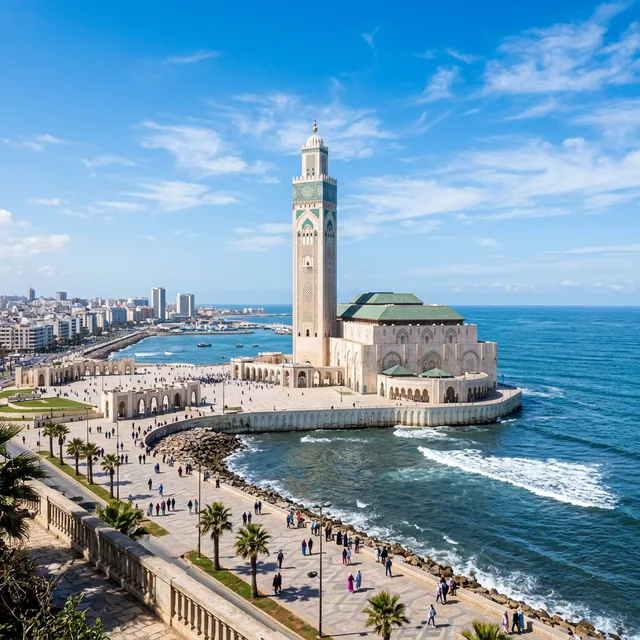
- Hassan II Mosque: The world’s third-largest mosque (after Mecca and Medina) was completed in 1993 and is the only mosque in Morocco that non-Muslims can enter on guided tours. It stands on a promontory over the Atlantic — the architect Michel Pinseau designed it so that worshippers look toward Mecca across the ocean. The 210-meter minaret is the world’s tallest, fitted with a laser that points toward Mecca at night. The retractable roof opens in fine weather. Tours run four times daily; book through the mosque website or authorized guides. The craftsmanship inside — hand-cut zellige tilework, carved cedar wood, wrought iron — is extraordinary.
- Royal Palace: The King’s official Casablanca residence occupies a large walled compound in the Anfa district. It is not open to the public, but the ceremonial gates and palace walls can be viewed from the surrounding streets. The palace guards in formal dress are a common sight. The surrounding Anfa neighborhood — established for European settlers in the early 20th century — has fine villas and wide tree-lined boulevards worth exploring.
- Old Medina (Casa Voyageurs): Casablanca’s original medina is small by Moroccan standards — unlike Fes or Marrakech, it was never a major imperial capital. The walled medina was built in the late 18th century and covers only a few hectares. It’s more authentic than the tourist souks of Marrakech and more manageable to navigate. The Wednesday flea market outside the walls is excellent.
- Central Market: The covered market in central Casablanca (Marché Central) has been operating since the 1920s. The fresh fish section reflects Casablanca’s position on the Atlantic — tuna, sea bream, sole, and prawns caught that morning are displayed on ice. The surrounding area has good café terraces. The market is busiest from 7am to noon.
- Colonial Architecture District: French protectorate architects built Casablanca almost from scratch in the early 20th century, creating one of the most coherent examples of Mauresque (Art Deco with Moroccan motifs) architecture anywhere. The area around Boulevard Mohammed V, the Central Post Office, and the Hyatt Regency hotel preserves this heritage remarkably well. The Villa des Arts (in a 1930s colonial mansion) hosts contemporary art exhibitions.
🌊 Atlantic Coastline & Beach Culture
Casablanca’s geographical features showcase North Africa’s coastal magnificence.
- Corniche Promenade: The coastal boulevard running from the Hassan II Mosque south through the Ain Diab neighborhood is Casablanca’s social spine. Lined with cafes, beach clubs, seafood restaurants, and the occasional patisserie, it sees heavy local foot and car traffic on warm evenings. The walkway closest to the water offers uninterrupted Atlantic views and a refreshing breeze. The area around the lighthouse (Phare d’El Hank) is particularly scenic at sunset.
- Ain Diab Beach: The main city beach stretches for several kilometers along the Corniche. Beach clubs (some free, most with entry fees that include a sun lounger) provide organized access to the water. The sea can be rough with strong Atlantic swells — check conditions before swimming. Summer weekends bring enormous crowds of Casablancans; weekday mornings are much more relaxed.
- Atlantic Ocean Views: The dramatic open Atlantic coastline visible from the Hassan II Mosque platform and from the Corniche promenade distinguishes Casablanca from Morocco’s interior cities. The ocean is genuinely rough and powerful here — different in character from the calmer Mediterranean. Rocky outcrops north of the mosque provide good wave-watching vantage points.
- Surf Culture & Water Sports: Casablanca and its surrounding coast (particularly Dar Bouazza and Skhirat to the south) have developed a surf scene over the past decade. The Atlantic swells generate consistent waves suited to intermediate and experienced surfers. Several surf schools operate along the Corniche and at the beaches south of the city.
- Marina & Yacht Club: The Casablanca Marina, developed in the early 2000s, added a modern waterfront complex with restaurants, a hotel, and a working boat harbor to the city’s coastal identity. The development is sleek but somewhat lacking in the character of the older Corniche. It functions as a gathering point for the city’s wealthier residents and visiting yachtsmen.
🏰 Modern Districts & Urban Development
Casablanca’s contemporary areas showcase Morocco’s economic dynamism.
- Gueliz District: The main French-planned district of Casablanca, with wide boulevards, European-style apartment buildings, and a dense concentration of banks, offices, and cafes. Boulevard Mohammed V is the central axis. The architecture ranges from 1920s Mauresque to brutalist 1970s blocks. The neighbourhood feels more European than North African in places — intentionally so by design.
- Maarif District: An affluent residential and commercial quarter with good restaurants, fashion boutiques, and patisseries. The streets around Rue Soumaya are particularly concentrated with food options. This is where middle- and upper-class Casablancans shop and eat; prices are higher but the quality of food and service reflects local rather than tourist standards.
- Twin Center: The two 28-story towers completed in 1999 mark the skyline of the business district and were Morocco’s tallest buildings for years. One tower houses offices; the other a luxury hotel. The complex functions as a visual landmark rather than a tourist destination, but the surrounding area — the financial and corporate heart of Morocco — is interesting for understanding Casablanca’s role as the country’s economic capital.
- Casa-Anfa District: The Anfa plateau was developed for wealthy European and Moroccan elites in the 1920s and 1930s. The grand villas — many now converted to offices or hotels — preserve the most intact examples of Casablanca’s interwar luxury architecture. The Anfa Hotel, where Roosevelt and Churchill met at the Casablanca Conference in January 1943 to plan the Allied strategy, was demolished (the site is a residential tower). A small memorial marks the conference location.
- Habous District: Built in the 1930s as a planned “new medina” to house rural migrants arriving in the city, the Habous quarter combines traditional Moroccan architectural vocabulary (arches, zellige, carved stucco) with French town-planning organization (regular streets, market squares). The result is charming and less chaotic than historic medinas. The covered souk sells honey, argan oil, spices, and traditional leather goods at more reasonable prices than the tourist markets.
🍲 Moroccan Cuisine & Culinary Heritage
Casablanca’s food scene represents the pinnacle of Moroccan culinary excellence.
- Tagine & Couscous: Morocco’s most iconic dishes take on Atlantic coastal character in Casablanca — fish tagines with preserved lemon and olives rather than the lamb-and-prune versions common inland. Couscous is traditionally served on Fridays (the day of communal prayer) and consists of hand-rolled semolina steamed over a broth of seven vegetables. Good versions require long preparation; restaurant couscous quality varies significantly. Rick’s Café (modeled on the film’s fictional bar) serves a reliable version in appropriately atmospheric surroundings.
- Pastilla & Seafood: Pastilla is one of Morocco’s most sophisticated dishes — a large pie of shredded poultry (traditionally pigeon, now more often chicken), egg, and almonds enclosed in paper-thin warqa pastry, dusted with cinnamon and powdered sugar. In Casablanca, seafood pastilla (with prawns or fish) has become a regional specialty. The combination of savory, sweet, and flaky is unlike anything else in North African cuisine.
- Mint Tea Culture: Moroccan mint tea (atay) is a ritual as much as a beverage — green gunpowder tea poured from height into small glasses to create a froth, sweetened generously with sugar, and accompanied by Moroccan pastries. The pouring from height aerates and slightly cools the tea. Refusing an offer of tea is considered impolite; accepting it is the first step in any social interaction. The best tea houses are in the medina and Habous quarter.
- Street Food & Souks: Casablanca’s street food centers on the Central Market and the medina perimeter. Sfenj (Moroccan doughnuts fried in oil and sold on strings) are the signature morning snack. Msemen (square flatbreads fried in butter) are eaten with honey or jam. The mahlaba (dairy stalls) serve fresh lben (fermented buttermilk) and raib (thick yogurt).
- Modern Moroccan Fusion: The restaurant scene along the Corniche and in Maarif has developed a confident contemporary Moroccan cuisine — traditional spice profiles applied to European cooking techniques, with an emphasis on local Atlantic seafood. Le Cabestan (on the Corniche cliff edge) and La Sqala (within a 18th-century city bastion) are well-regarded examples combining setting and cuisine.
- Arabic Sweets & Desserts: Moroccan patisseries produce some of the Arab world’s finest pastries — ghribas (almond shortbreads), chebbakia (honey-soaked fried pastry), briouat (almond and orange blossom parcels), and kaab el-ghzal (“gazelle horns” — almond paste in thin pastry). The best patisseries concentrate in the Habous district and the Maarif neighborhood. Many use orange blossom water and argan oil in quantities that make the finished product distinctively Moroccan rather than interchangeable with Middle Eastern versions.
🎭 Cultural Heritage & Moroccan Traditions
Casablanca’s cultural institutions showcase Morocco’s artistic excellence and Islamic heritage.
- Moroccan Cultural Festivals: The Casablanca Festival is held annually in the summer and features international music acts alongside Moroccan artists. The Festival International du Cinéma de Casablanca celebrates North African film. During Ramadan, the city transforms — restaurants and cafes are closed during the day but the streets come alive after iftar (the sunset meal breaking the fast), with markets, music, and outdoor gatherings running past midnight.
- Islamic Art Collections: The Villa des Arts, housed in a 1930s Art Deco mansion near the Twin Center, hosts rotating contemporary art exhibitions alongside a permanent collection of Moroccan modern art. The museum is free and less visited than it deserves. The Musée de la Fondation ONA in Anfa covers Moroccan craft traditions — ceramics, weaving, and jewelry from different regional traditions.
- Contemporary Moroccan Art: Casablanca has a more developed contemporary art scene than most Moroccan cities, a legacy of the Casablanca Art School established in the 1960s. Artists like Mohamed Chebaa and Farid Belkahia developed a distinctly Moroccan modernism that drew on Islamic geometric tradition and African motifs. Their work appears in several private galleries in the city.
- Arab-Andalusian Music: The classical Andalusian music tradition (brought to Morocco by Muslims and Jews expelled from Spain in 1492) remains alive in Casablanca. The Conservatoire de Musique de Casablanca teaches the tradition; performances are advertised in local cultural listings. The music’s complex modal structures and poetic texts are distinctive from Arabic popular music.
- Calligraphy & Islamic Design: The Hassan II Mosque demonstrates the living tradition of Moroccan decorative arts — the calligraphy, zellige patterns, and stucco carving inside were produced by thousands of artisans from across Morocco. The Museum of Moroccan Arts (Dar Si Said) in Marrakech has the best general collection, but Casablanca’s craft school (the ESAV) produces and exhibits contemporary work in these traditions.
🚇 Practical Casablanca Guide
- Best Time to Visit: April-June or September-November for mild weather and fewer crowds, or December-March for winter sun but expect occasional rain. The Atlantic climate keeps temperatures moderate year-round — cooler and windier than Marrakech in summer, wetter in winter. Ramadan significantly affects restaurant access and opening hours; plan accordingly or embrace the altered rhythm.
- Getting Around: Casablanca has a modern tram system (2 lines) covering key routes including the airport, and an expanding bus network. Grand taxis (shared long-distance taxis) and petits taxis (city taxis) are widely available. Ride-hailing apps (Careem) work in the city. Walking works well in the Corniche, Habous, and city center but distances are large in the newer districts.
- Planning & Tickets: Book Hassan II Mosque tours in advance, especially in peak season. Tours run at set times (usually 9am, 10am, 11am, and 2pm for non-Muslims) and last 1-1.5 hours. The mosque website lists current schedules and admission prices (around 120 MAD).
- Safety & Etiquette: Generally safe in tourist areas but use common sense in crowded places. Moroccans are friendly and welcoming. Respect religious customs. Bargain politely at souks. Dress modestly at religious sites. The culture is hospitable. The people are warm.
- Cost Considerations: Affordable for North Africa standards but higher in tourist areas. Budget €50-90 per day. Street food inexpensive. Local dining reasonable. Luxury experiences costly. The city offers good value for North Africa.
- Cultural Notes: Casablanca is Morocco’s commercial capital but not its cultural or political heart — those roles belong to Marrakech, Fes, and Rabat respectively. The city feels more cosmopolitan and less traditional than other Moroccan cities, and visitors expecting medina bazaars and riads will find something quite different. It rewards visitors who engage with its Art Deco heritage, Atlantic character, and contemporary Moroccan urban culture.
- Language: Arabic and French primary, with Berber widely spoken. Casablanca is multilingual. The Arabic is primary. Communication is possible. The diversity is linguistic.
- Time Zone: Western European Time (WET), UTC+0. No daylight savings time.